01 · Question
The question the parent's ratio cannot answer: does each side actually have hot gas
NGC 4634 is an edge-on spiral galaxy currently infalling into the Virgo cluster. Whether ram-pressure stripping removes its hot (~10⁶ K) halo phase — and preferentially on the leading side — is a belief that actually decomposes into two independently falsifiable parts: (a) stripping (whether the hot phase has disappeared on some side) and (b) anisotropy (whether it disappeared preferentially on the leading side). The parent I110 measures only the ratio R = Σ_lead / Σ_trail, which can answer (b) but is structurally unable to answer (a).
I178 measures two absolute quantities: on the merged XMM EPIC archive, separately estimate the source-masked 0.5–2.0 keV surface brightness Σ_k of each minor-axis sector (leading / trailing), each referenced to a frozen, detector-qualified background model B. The two estimands are Σ_lead − B and Σ_trail − B, each with an error interval. Each sector independently yields one of four mutually exclusive outcomes: PRESENT / BOUNDED ABSENT / PRESENT-BUT-UNATTRIBUTED / INCONCLUSIVE.
02 · Why it matters
Environmental CGM-stripping literature asserts "removal", yet no operator in this lineage has ever reached it
The model lineage of environmental CGM removal — Boselli & Gavazzi-type stripping calibrations, Tonnesen & Bryan (2010)-type simulations — predicts that hot-phase stripping has a shorter timescale than cold-gas stripping. This is a prediction about removal (i.e. part (a)). Yet Tüllmann et al. (2006)'s first detection of the NGC 4634 halo used local in-field background subtraction, which, like the parent's ratio, cancels the common-mode background term — so both have never established the absolute Σ_k − B amplitude of either side.
Downstream work that specifically depends on this:
- Environmental CGM-removal models (Boselli & Gavazzi stripping calibration; Tonnesen & Bryan 2010 simulations) — they predict the hot phase is stripped first, and this is a prediction about (a).
- Q091's new-observation plans I092 (NGC 4569) / I093 (NGC 4388) — their scales all rest on the prior of "how much hot halo survives after infall," for which no absolute archival measurement yet exists in any Virgo edge-on spiral.
- The Tüllmann+2006 lineage — its NGC 4634 detection is a shallow-epoch (37 ks PN) statement, never re-referenced to a frozen absolute background on the 2.5× deeper 2007 data.
- Portfolio prevalence syntheses (I174/I175 shape) — they consume per-target "absolute present/bounded" labels, not ratios.
This is not "validating a stripping model." A single archival measurement of one galaxy can only update the evidence for NGC 4634 at this angular scale, this band, and this sensitivity — it constrains this galaxy, this epoch, this line of sight.
03 · Sky geometry
Both archival pointings are nucleus-centred; no dedicated halo-offset field exists — nor is one needed
NGC 4634's RC3/SIMBAD D25 is 3.07′ × 0.65′, b/a=0.21, PA=156° (almost perfectly edge-on). The aimpoints of the two public XMM EPIC science ObsIDs (0202730301, 2004; 0504240101, 2007) both fall within 0.433′ of the nucleus, and their nominal 15′ FoV fully covers the D25. The detected halo scale is ~1.2′ (R4 REFRAME R01), far within the FoV. The figure below is a nucleus-centred display field: it shows nominal sky geometry only and does not freeze I178's sector radius, opening angle, infall-bearing correction, or detector footprint.
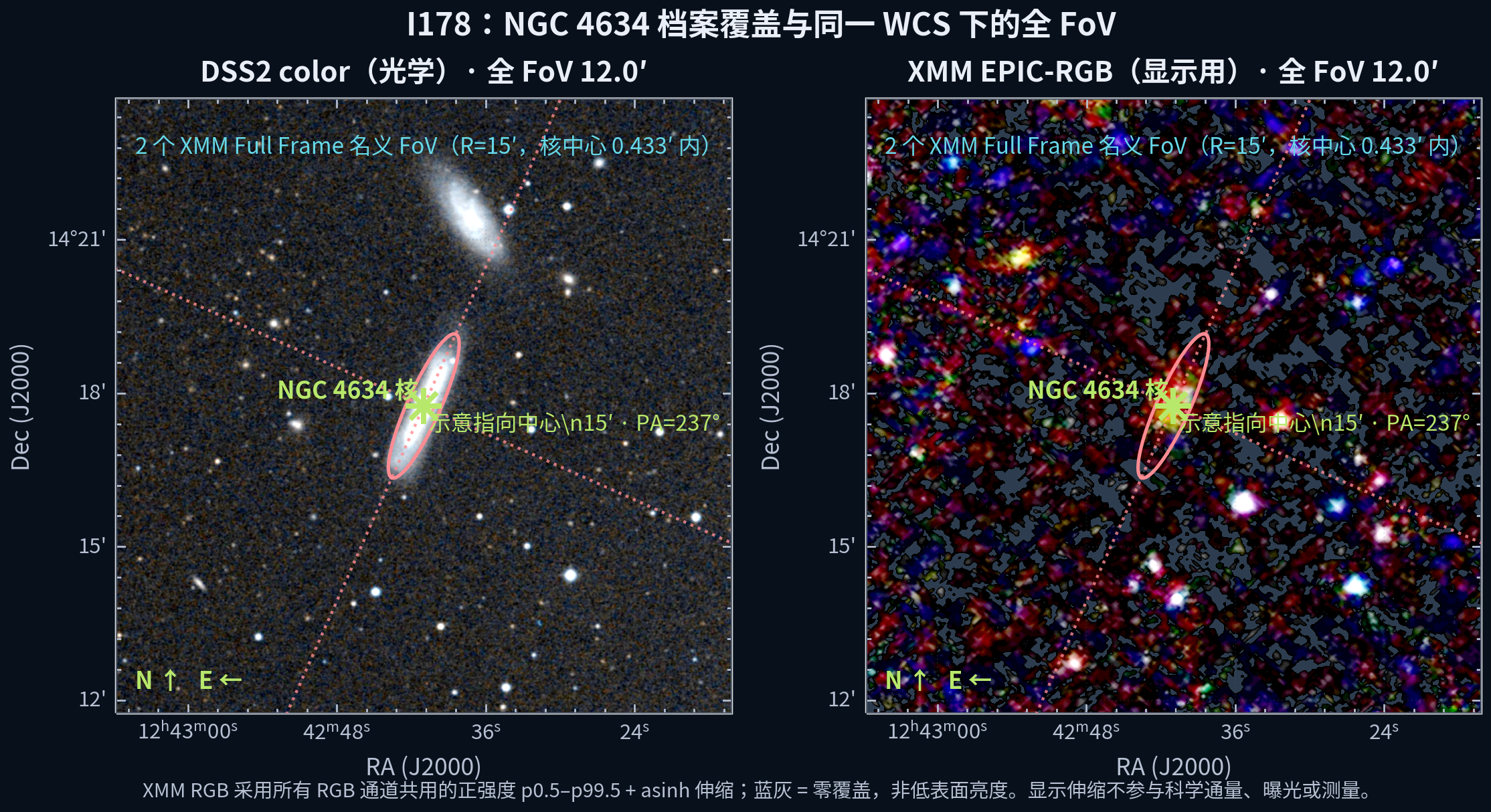
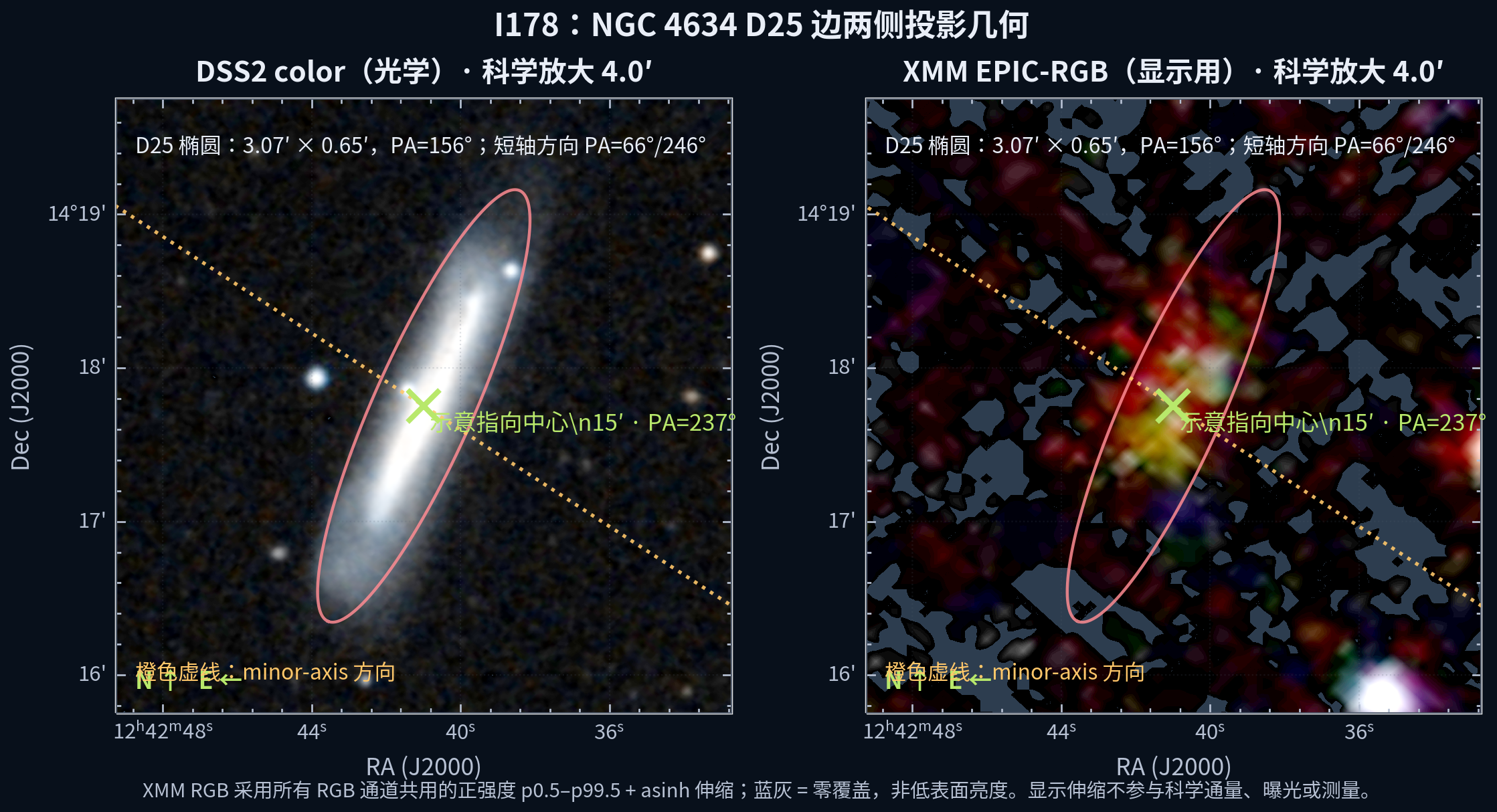
The XMM RGB uses a positive-intensity p0.5–p99.5 percentile clip shared across all channels and an asinh stretch; blue-grey marks zero coverage, not low surface brightness. This display stretch plays no role in exposure correction, scientific flux, or the Σ_k − B measurement; the overlays use the original WCS.
04 · The number actually measured, and why the parent cannot be reused
The measurement is each sector's absolute amplitude, not the two-sided ratio
The estimands are two continuous quantities Σ_lead − B and Σ_trail − B, each with an interval. Sectors are placed at "the scale where the halo is actually detected in this object" (~1.2′, R4 REFRAME R01), not the parent's declared 0–7′ range — because an absolute measurement is background-limited, and a domain with no expected emission is not worth the cost. The precise sector radius, opening angle, and infall-bearing correction are to be frozen at the evidence stage (I178-E2); they are not asserted here.
Exactly one outcome per sector:
- PRESENT — after recovery qualification,
Σ_k − Bmeets the pre-registered criterion: the sector hosts an absolute diffuse soft component, independent of comparison with the other side. - BOUNDED ABSENT — recovery qualification passes, and the interval excludes a pre-registered material-amplitude threshold: an absolute upper limit on that sector's hot gas. This is the statement the parent structurally cannot make, and the branch that carries the ram-pressure-stripping science.
- PRESENT-BUT-UNATTRIBUTED — a positive
Σ_k − Bis measured, but at the available depth it cannot be separated from unresolved point sources, the wings of the companion NGC 4633, or line-of-sight Virgo ICM projection. This is a named positive result reported with an interval, not a failure. - INCONCLUSIVE — only reserved for failure of the pre-declared detector / mask / background / response recovery qualification.
05 · If the answer comes out the other way, or cannot be answered at all
An honest bounded null is informative; an unqualified null is not
Note the wording: not detected does not mean absent. BOUNDED ABSENT is not "no halo on either side", but "at this aperture, this band, and this actually-achieved sensitivity, the surface brightness is below S." The halo could be fainter, hotter, colder, or outside the extraction region.
- Leading BOUNDED ABSENT + trailing PRESENT: a direct, quantitative detection of hot-phase stripping in a Virgo-infalling spiral — the strongest result this archive can yield.
- Both sides BOUNDED ABSENT: the branch the parent can never distinguish from its own null, and the one that most tightly constrains stripping efficiency — a halo detected at low significance in 2006, bounded-away in a deeper absolute analysis, is an informative revision, not a null result. It enters a detection-rate denominator.
- Both sides PRESENT with comparable amplitude: this object's hot CGM is more resilient than the removal models assume — a two-way move on the belief above.
- Either side PRESENT-BUT-UNATTRIBUTED: quantifies the depth at which this question becomes answerable, directly pricing any future new-observation request.
- INCONCLUSIVE: if the achieved sensitivity was never qualified, the honest word is INCONCLUSIVE — an honest INCONCLUSIVE is more valuable than a packaged null.
06 · Cost, and the cost still unknown
Archive track: no observing time requested; the single request is to first authorise one qualification HEAVY
This is track: archive. The data already exist — two nucleus-centred XMM EPIC science ObsIDs (0202730301, 2004; 0504240101, 2007), PN 129.022 ks / MOS1 132.186 ks / MOS2 132.200 ks. These are scheduled/v_exposure numbers, not clean exposure. The clean-GTI fraction after soft-proton screening remains unresolved (I178-E4, inherited from the parent I110-E4 and tightened). Zero Chandra named for NGC 4634, zero NuSTAR. No new observation is requested at birth, and none may be requested until I178-E1 closes.
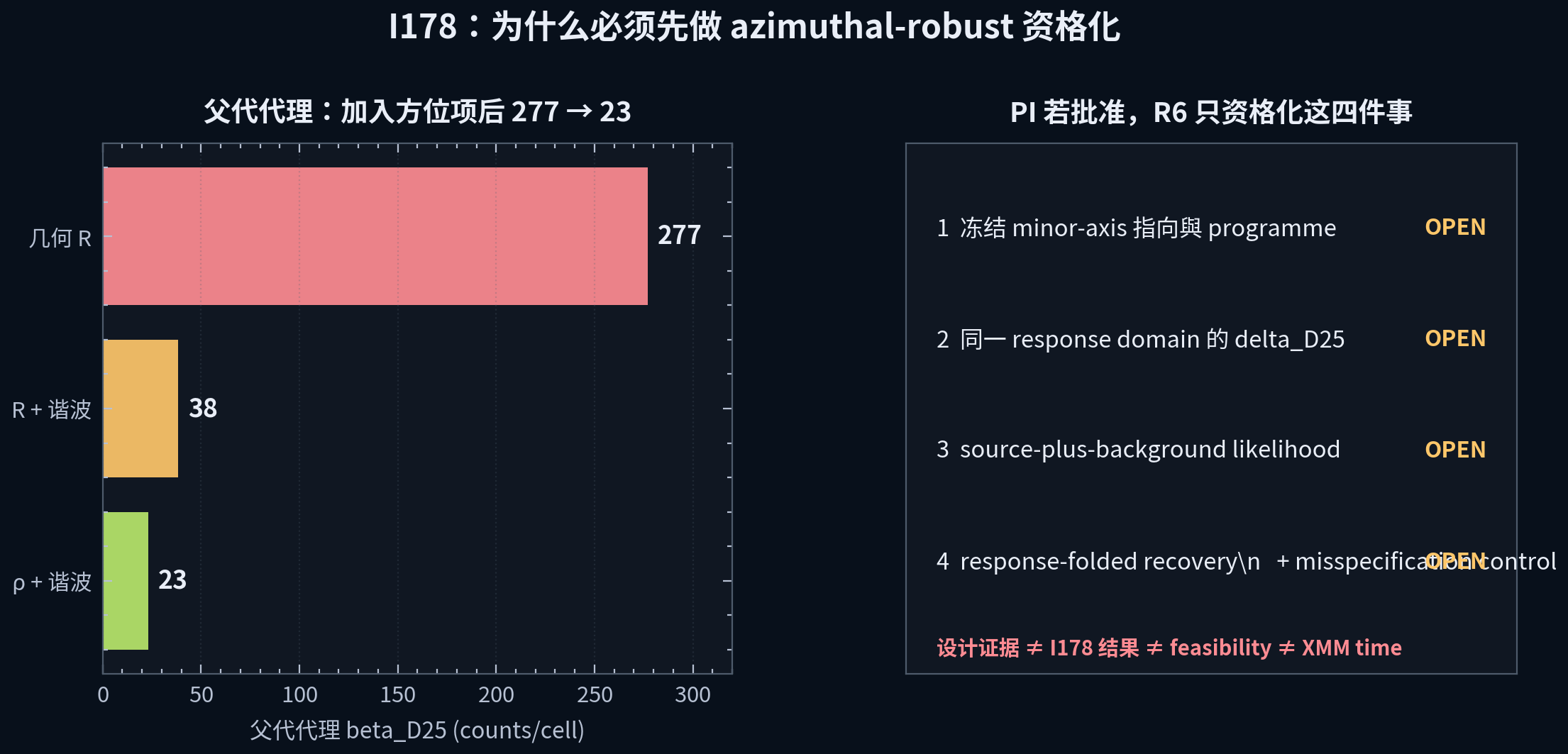
The truly unknown cost is whether the background can be frozen tightly enough. The parent's ratio is robust to background by construction — the common-mode background term cancels in Σ_lead / Σ_trail. This fork deliberately gives up that robustness in exchange for reachability, so every background term enters as σ_sys: QPB normalisation, CXB and its cosmic variance (b=+77°), solar-wind charge exchange, residual soft protons after GTI screening, and the source-masking completeness floor of the unresolved point-source population. R4 EMPIRICAL E01 has already noted that at realistic EPIC pn background rates of 7–15×10⁻³ cts/s/arcmin², S/B drops from 0.6 to 0.3–0.2. This is why I178-E1 is a blocking gate: an absolute operator that cannot qualify its own background measures nothing.
Actionable choice for the PI
Approve: approve only the R6 HEAVY qualification package (freeze background model + response-folded injection/recovery + GTI screening). It does not automatically approve any XMM time request — and this page makes no time request.
Do not approve: stop here. This page has already stated that there is currently insufficient evidence to commit observing time or to claim a halo/CGM result.
Sources and reproducibility
Evidence boundary of this page
- Tüllmann, Pietsch, Rossa, Breitschwerdt & Dettmar (2006), The multi-phase gaseous halos of star forming late-type galaxies — I. XMM-Newton observations of the hot ionized medium, A&A 448, 43.
- Tonnesen & Bryan (2010), The Evolution of the Circumgalactic Medium in Cluster Environments, ApJ 709, 1203. DOI
- Boselli & Gavazzi (2006), Environmental Effects on Late-Type Galaxies in Nearby Clusters, PASP 118, 517. DOI
- Local traceable inputs: the I178 idea card (fork of I110), R3 evidence (
cycles/cycle-obs9/evidence/idea-I178.md), R4 critique/rebuttal (D051 anchor SHA-2561c414a6c…), R5 adjudication, NGC 4634 source card, and the frozen HiPS2FITS display inputs of this page. All hashes, commands, and replay paths are recorded in the publication manifest.